
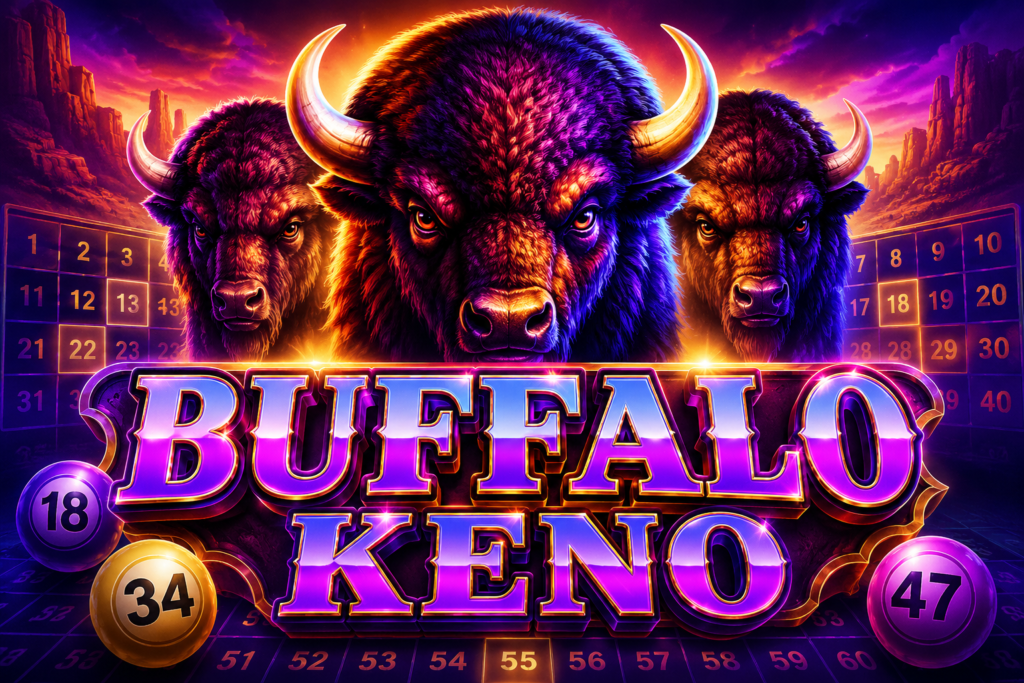
Buffalo Keno is what happens when someone looks at a regular keno and goes, “What if we slapped a Buffalo slot on this so people actually care?”
If you’ve ever watched a Buffalo Keno bonus clip on YouTube, you know the vibe: coins, multipliers, buffalo heads, free games, and someone yelling when an 8x hits on a ticket that was already hot. Underneath all of that, it’s still keno pick numbers, 20 numbers are drawn, match enough and you get paid but the game wraps it in the same “Buffalo!” energy you see on half the casino floor.
This site hangs around the Juwa / sweeps / casino‑adjacent niche, so we’re not going to pretend Buffalo Keno is “a system” or some low‑edge hack. It’s high-edge lotto with steroids and a good soundtrack. What you can do is understand how the rules and multipliers actually work, what the odds and house edge look like, and how people hit those big wins without lying to themselves about what it costs to get there.
THE THING NOBODY ACTUALLY SAYS OUT LOUD
Nobody says this on Buffalo Keno bonus clips, but here you go: Buffalo Keno isn’t magically better odds than regular keno it’s regular rotten keno odds wearing a Buffalo slot costume.
Start with keno itself. Britannica: keno is a gambling game using numbers 1 to 80, you pick numbers, 20 are drawn, and the house advantage is “considerable — about 25 percent.” Wizard‑style breakdowns and modern guides agree: most keno implementations sit in a 20–40% house‑edge band, making it one of the worst games in the casino in pure math terms.
Buffalo Keno doesn’t change that core math. It just layers Buffalo slot mechanics on top:
- You still pick spots on a 1-80 card, and 20 numbers are drawn at random.
- If your ticket is “winning” (enough hits based on the paytable), the game might trigger a Buffalo‑style feature: multipliers, coins, extra spins.
- Coins that land on your numbers can apply 2x, 4x, and higher multipliers to your win, and multiple coins can stack to 8x on some versions.
One Buffalo Keno bonus video spells it out mid‑play: land a pair of coins on a winning ticket and you get a 2x multiplier; add more coins and the multiplier climbs up to 4x and beyond, sometimes alongside free extra games. That’s not some secret edge. That’s exactly how Buffalo slot bonuses work: stack multipliers, push volatility, keep you spinning.
You also never see the boring data in those videos: how many losing tickets came before that 8x highlight, or how many “almost” hits ate bankroll without making the cut. The base keno odds still apply: your chance of hitting a particular set of spots is determined by simple combination math, and each number has the same chance each draw.
The other thing no one says out loud: Buffalo Keno is built to attract people who hate “plain vanilla” keno. One player in a video literally says they wouldn’t enjoy regular video keno but a Buffalo version “would certainly interest me.” It’s gambling UX 101: same math, nicer skin.
So the truth you’re not going to get on a slot channel thumbnail:
- Buffalo Keno is not “more beatable.”
- The house edge is still large; you’re just getting more swing and more sensory reward when you do hit.
- Big wins you see are what happens when high variance lines up, not proof there’s a strategy that dodges the edge.
HOW THIS ACTUALLY WORKS THE REAL MECHANICS
Let’s translate the hype into something you can actually use at a table or in an app.
The base engine: still keno
Under all the Buffalo art, Buffalo Keno runs on the same core engine every standard keno guide describes:
- The “card” uses numbers 1 to 80.
- You pick how many “spots” you want to play (how many numbers), often between 1 and 10, sometimes up to 20 in video keno.
- The game draws 20 numbers at random from 1-80.
- You win based on how many of your picks show up, according to a paytable.
Casino.org and wikiHow both walk through the generic steps: select your numbers or use Quick Pick, choose bet size, check the payout table (what you get for 3/5, 4/6, etc.), then watch as 20 balls or RNG hits roll out. Buffalo Keno doesn’t mess with that part.
The Buffalo layer: coins, multipliers, free games
Where Buffalo Keno gets spicy is in its bonus logic. Watching actual machine footage tells you more than any marketing blurb:
- On a winning card, if a special coin symbol appears on a number you hit, it can apply a multiplier to your payout.
- One explanation: a pair of coins landing on your winning card triggers a 2x multiplier; additional coins can increase that to 4x and even 8x on some machines.
- Hitting the right combination can also award free games, where your existing numbers stay in play with the bonus active.
That’s the Buffalo slot DNA: the game takes a normal win distribution and adds “Buffalo moments” where multipliers blow up certain hits. In practice this means:
- You get more dead spins and small returns (because some EV is siphoned into rare big events).
- When bonus coins and multipliers line up with a high‑spot hit, the result is flashy enough for YouTube clicks.
Odds and big wins: what’s actually happening
Even in Buffalo Keno, your odds of catching certain numbers are the same as in regular keno. The probability of hitting exactly
r
rnumbers when you’ve picked
n
nspots and 20 are drawn from 80 is still:
P(hit r of n)=(nr)×(80−n20−r)(8020)
P ( hit r of n )=(2080)(rn)×(20 − r80 − n)
The “big win” videos are usually one of two things:
- A relatively high‑spot ticket (like 7–10 spots) that hit many of its numbers and had coins land on those same hits, stacking multipliers.
- A more modest card (like 4–6 spots) that hits a full card or near-full card during a free-games round with multipliers active.
From the casino’s point of view, they’ve simply redistributed a chunk of overall payout into those rare scenarios while keeping the long-term house edge large. That’s why guides like Britannica and Wizard of Odds keep warning that keno’s edge can sit between roughly 25% and 40% — and Buffalo branding doesn’t move that needle in your favor.
Short list, with opinions:
- Buffalo Keno is keno plus volatility: more nothing, bigger spikes.
- Coins and multipliers don’t change the underlying RNG, they just decide how hard you get paid when you already got lucky.
- If you’re here for big wins, you’re trading predictability for hype; that’s the deal.
COMPARISON WHAT’S ACTUALLY DIFFERENT BETWEEN YOUR OPTIONS
You’re basically choosing between three flavors when you’re in a keno lobby.
| Option | What it actually does | Who it’s for | The catch |
| Plain / standard keno | Pick spots, 20 numbers drawn, fixed paytable, no theme. | People who just want simple, steady keno | High house edge, fewer big “wow” moments. |
| Video keno (no theme) | Same rules, but on a machine / app, often with auto‑play and simple multipliers. | Players who like speed and volume | Easy to burn through bankroll fast with rapid draws. |
| Buffalo Keno | Video keno with Buffalo theme, coin multipliers, Buffalo‑style bonus/free games. | Players who love Buffalo slots and big-win potential | Volatility spikes; more EV locked in rare coin/multiplier events, edge still high. |
If you want chill, low‑drama keno, the themed Buffalo version is not it. If you want occasional big clips and don’t mind long stretches of “nothing,” Buffalo Keno is exactly your flavor as long as you treat it like an expensive entertainment product, not a strategy game.
WHAT ACTUALLY HAPPENS WHEN YOU TRY THIS
Sit down at a Buffalo Keno machine in Vegas or fire up a similar game online, and it feels different from the “old person in a bingo lounge” keno stereotype instantly. The screen looks like a Buffalo video slot: desert background, buffalo symbols, coins, maybe sound bites straight out of the OG Buffalo universe.
You still start like any keno game:
- Pick how much you want to bet per draw.
- Choose how many spots you want to play say 6, because every guide you’ve read says 4–8 is sane.
- Mark your 6 numbers on the 1–80 grid.
The first few games, it’s just keno with better sound design. Numbers pop, some of your picks light up, most don’t. You get paid small when you catch enough. It’s familiar if you’ve played any version of keno before.
Then you hit your first Buffalo twist. You land a “winning card,” and suddenly coins appear over some of your matched numbers. A message flashes: 2x multiplier on that win. You see your payout double. For a second, it feels like you broke the game, even though multipliers are the entire point.
The thing that surprised me the first time I watched real Buffalo Keno play: multipliers and free games don’t trigger on blank tickets; they stack on already winning tickets. That means:
- You can have a run where you hit nothing and see zero Buffalo magic.
- You can have a run where you hit decent combos and the coins land badly, so you get “eh” multipliers.
- And then once in a while, you hit a strong card and the coins stack, and the machine suddenly looks generous.
In one video, a player explains that they got a 2x multiplier just from coins on a win, and additional coins pushed it as high as 8x, with extra free games being added when numbers land on coins. Watching a full bonus, you see what’s going on: the base keno card behaves normally, the multipliers just ride on top of whatever your hits would have been.
What no one shows you in a single clip is the pattern over hundreds of games:
- Lots of dead draws where you hit one or two of your numbers and get nothing.
- A decent number of “mini‑wins” where you get your stake back or a small profit.
- Occasionally, a “decent win” where you hit 3–5 out of your spots and maybe one multiplier.
- Rarely, a “YouTube win” where your card is hot and multipliers stack to 4x, 8x or similar.
When you actually track your bankroll over a session, it lines up with what generic keno explainers warn: the house edge is still brutal, so your graph trends down even if it has some nice spikes. The Buffalo elements mostly affect:
- How fast you lose (volatility).
- How emotionally loud your wins are.
You also notice a very human thing: after a big Buffalo Keno hit, your brain feels invincible. You want to raise your bet “with the casino’s money.” If you actually check the math afterward how many losing games led up to that hit it usually works out to “nice moment, still negative overall.” That’s exactly why long-form keno guides and even WikiHow tell you to set strict budgets and treat every session as a paid show, not an investment.
THE ADVICE EVERYONE GIVES VS WHAT ACTUALLY WORKS
1. “Buffalo Keno has better odds because of the multipliers.”
That’s the marketing vibe, but not what the math says. Keno in general has a house edge around 25–40% depending on the exact game and paytable. Buffalo multipliers redistribute some of that expected payout into fewer, bigger events they don’t turn keno into a low‑edge game. Watching big‑win videos without seeing the preceding losses hides that reality. The honest lens: multipliers raise volatility and make rare hits more dramatic; they don’t make the game “good value.”
2. “Pick more numbers in Buffalo Keno so you can hit coins more often.”
Yes, more spots means more chances to match drawn numbers and coins. It also means you need more hits to make any profit, and high-spot cards in keno are notoriously high-variance. Standard strategy advice — including from Casino.org and YouTube explainers — is still “most players stick to 4–8 numbers” because that range offers a healthier balance of hit frequency and payouts. In Buffalo Keno, pushing to 10+ spots makes you way more dependent on perfect storms of hits and multipliers.
3. “There’s a Buffalo Keno pattern that hits more often.”
Every generic keno source hammers the same point: each number from 1 to 80 has the same probability of each draw; Past results don’t change future odds. Layout, shapes, “buffalo head clusters” all of that is for your brain, not for the RNG. If you see someone selling a Buffalo Keno “system,” they’re repackaging basic keno advice at best. The realistic alternative is boring: pick a modest number of spots, spread them across the board, and accept that the game is variance, not prophecy.
4. “Buffalo Keno is basically a slot, so just ride the streaks.”
It feels like a slot, but the underlying structure is still a 20-ball draw. Unlike slots, where RTP can sometimes be in the 94–97% range, keno’s expected returns are much lower. Treating it like a high‑RTP slot encourages over‑betting and long sessions that the math simply devours. If you’re going to play Buffalo Keno, treat it as the high-edge game it is: small bets, short sessions, enjoy the theme, don’t chase “streaks” that are just random clusters in a huge sample space.
THE PRACTICAL PART WHAT TO ACTUALLY DO
1. Learn the basic keno rules once, then map them to Buffalo Keno.
Before you get distracted by buffaloes and coins, make sure you can explain regular keno in one breath: pick 1–20 numbers from 1–80, 20 numbers are drawn, you’re paid according to a paytable based on how many you hit. When you sit at Buffalo Keno, check that it’s still using a 20‑ball draw and see what range of spots you’re allowed to choose; that’s the skeleton you’re actually playing on.
2. Decide your spot count (4–8 is sane) before you even choose numbers.
Generic keno guides repeatedly say most players and basically all “strategies” live in the 4–8 number range because it balances hit rates and payouts. For Buffalo Keno, pick a count in that range (like 5 or 6) and commit to it for a session. That keeps your variance in check even when multipliers spike your wins and tempt you to go “full board mode.”
3. Start with flat, small bets and only escalate if you’re comfortable losing it back.
Because Buffalo Keno is essentially high‑edge keno with high‑volatility bonuses, you should be betting small relative to your total session budget. Think 1–2% of your budget per draw, like the more honest keno strategy explainers suggest for regular keno. If you do hit a big win during a bonus (say 50–100x your bet), decide beforehand how much of that you’re willing to recycle and how much you’ll treat as cash‑out fuel.
4. Use one number pattern per session and stop redesigning every time you miss.
Buffalo Keno doesn’t care if your spots are in a straight line, a cluster, or a cute buffalo head outline. But you care. Pick a pattern spread numbers across the ticket or build a simple shape and stick with it for at least 30–50 games. That consistency makes it easier to see whether your bet size and spot count feel sustainable instead of constantly chasing a magical layout that doesn’t exist.
5. Treat multipliers and free games as variance, not a signal to “push.”
When you finally get a coin hit, extra free games, or some 4x / 8x madness, enjoy it then zoom out. Those features are designed to give you rare high points in a long negative-EV game. Don’t respond by doubling your bet or adding more spots “while it’s hot.” Set a rule like: after a bonus, you either drop stakes back to normal or end the session if you’re up a certain amount.
6. If you’re in a sweeps / Juwa‑style environment, test Buffalo Keno with play / Gold coins first.
A lot of online casinos and sweeps platforms offer Buffalo‑style keno in free‑play or coin‑only modes. Use those to test:
- How fast the game eats a fixed bankroll at your chosen bet size and spot count.
- How often bonuses show up for you over 100+ draws.
Only move to anything redeemable once you’ve seen in practice how violent the swings feel.
7. Decide your loss limit and a boredom limit before you start.
Because Buffalo Keno is pretty but mindless, it’s easy to slide into autopilot. Set two caps: a maximum amount you’re willing to lose this session, and a maximum number of draws you’ll play even if you’re flat. When you hit either bankroll or “okay, that’s enough buffalo yelling for one night” walk away. That’s the only real “strategy” that works over months, not minutes.
QUESTIONS PEOPLE ACTUALLY ASK
How do you play the Buffalo Keno game?
Buffalo Keno starts like regular keno: you choose how much to bet per draw, pick a set of numbers (spots) from 1 to 80, and then the game randomly selects around 20 numbers. If enough of your picks match, you have a winning card and Buffalo‑style features can kick in — coins, multipliers, and sometimes free games on top of your base keno payout. The exact rules (how many spots, how big the multipliers) depend on the specific machine or online version you’re playing.
What makes Buffalo Keno different from normal keno?
The underlying draw is the same — a lottery‑like game picking 20 numbers from 80, paying based on how many you match. Buffalo Keno adds a slot‑style Buffalo theme, where coins can land on your winning numbers to apply multipliers (like 2x, 4x, or even higher) and bonus features like free games. So you get the same basic odds, but with extra volatility and more dramatic “big win” moments.
What are the odds like on Buffalo Keno?
No matter the skin, keno is a high house‑edge game. Britannica and video explainers put the typical keno house edge between roughly 25% and 40%, depending on the rules and paytable. Buffalo Keno doesn’t magically improve those odds; it redistributes payouts so that some wins are multiplied in bonus rounds, while many draws pay nothing or very little. The precise RTP will vary by machine, but you should assume it’s in “rough on your bankroll” territory.
How do the multipliers and coins work in Buffalo Keno?
In many Buffalo Keno versions, when you have a winning card, special coin symbols can land on your hit numbers and apply multipliers to your payout. One popular machine example shows that landing a pair of coins on a winning card gives a 2x multiplier, and more coins can raise that multiplier to 4x and beyond, sometimes up to an 8x total. Hitting coins can also trigger extra free games where your numbers stay active, giving you more chances to benefit from multipliers.
Can you win big on Buffalo Keno, or is it all small payouts?
You can win big — that’s exactly what the YouTube “Buffalo Keno Jackpot Win” videos are showing. Big wins usually happen when you hit many of your chosen spots on a single card and stack multipliers during a bonus round. But like any high-variance game, huge payouts are rare and sit on top of a large number of losing or break-even tickets. Treat big wins as lucky outcomes, not something you should expect every session.
Is there a strategy for playing Buffalo Keno?
There’s no strategy that changes the math of the draw each number has the same chance of being selected each game. What you can control is how many spots you pick (often 4–8 is recommended in keno guides), how much you bet per draw, and how long you play. Good “strategy” here means managing your bankroll, picking a spot count that fits your risk tolerance, and keeping sessions short instead of chasing losses.
Is Buffalo Keno better than regular keno for my bankroll?
“Better” depends on what you want. If you care strictly about preserving your bankroll and don’t care about flashy bonuses, a simple keno game with a decent paytable may feel more predictable. If you want occasional big hits and are okay with more swings, Buffalo Keno gives you that through multipliers and free games. Either way, both are high-edge games; neither is a good choice if your main goal is long-term profit rather than short-term entertainment.
Can I play Buffalo Keno online legally in the USA?
Some regulated online casinos in legal states (like DraftKings Casino in NJ, MI, etc.) offer keno‑style games, and certain platforms may carry Buffalo‑branded keno or similar themed video keno. Availability depends on your state’s laws and the site’s game library. Always check that the online casino is licensed in your state, and remember that in many US states online casino games (including keno) are still restricted or unavailable.
SO WHERE DOES THIS LEAVE YOU?
Buffalo Keno is basically a marketing crossover: take one of the highest‑edge games in the building and skin it with the most famous slot in the building. If you know that going in, it becomes a loud, occasionally fun way to burn a small, controlled amount of money. If you don’t, it becomes a place where you talk yourself into “just one more” because the last bonus almost did something crazy.
For an 18–25‑year‑old orbiting Juwa and sweeps apps, the smart move isn’t “never touch Buffalo Keno” it’s “never pretend Buffalo Keno is a grind game.” Set stakes that let you enjoy the multipliers without caring if they whiff, keep your spot count sane (4–8), and treat every session as a ticket to a Buffalo‑themed show where the house edge is the cover charge.
If you want one concrete step: next time you sit down, take whatever bankroll you’re willing to lose on Buffalo Keno, divide it by 50, and make that your per‑draw bet size for 5–6 spots. Play 50 draws, log the damage, and decide if the multipliers felt worth that ticket price. That reality check will do more for your “strategy” than any coin-pattern superstition.
You made it through a full breakdown of Buffalo Keno, which already puts you a tier above “clicked because the buffalo looked cool.”
Now you know the game is still keno under the hood, why the multipliers don’t rescue the house edge, and how those ridiculous YouTube hits are just the loud side of a math model that spends most of its time quietly taking small bites out of your bankroll. You don’t have to avoid Buffalo Keno forever. You just have to stop giving it more money than the entertainment is worth.
So next time the machine screams “BUFFALOOOOOO,” enjoy it but maybe enjoy it at 50 cents a draw instead of “rent plus ego.”