
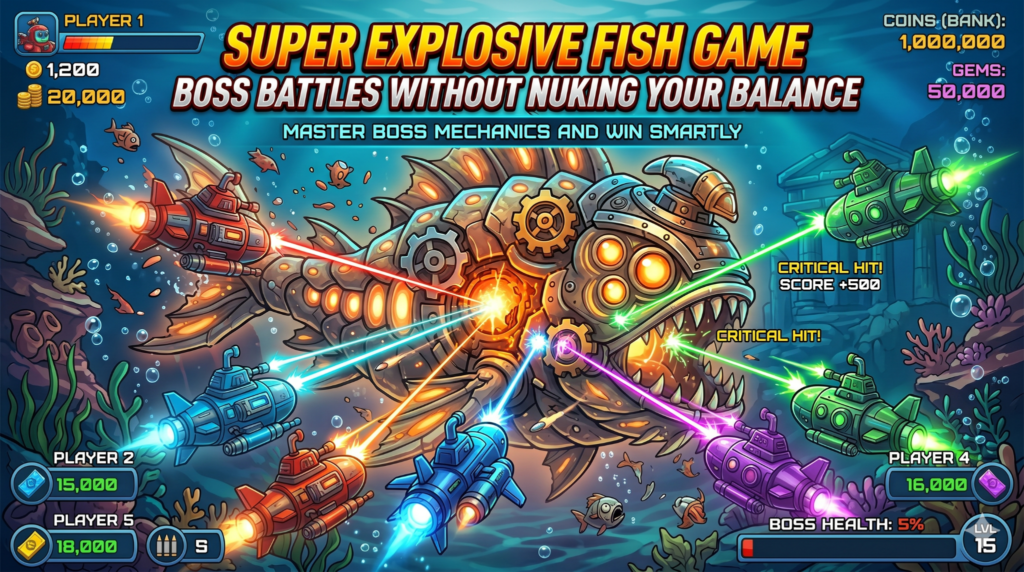
You haven’t really felt pain until you’ve burned half your balance on a huge glowing boss fish… and watched someone else land the last hit and scoop the payout. That’s fish tables in general, and every “Super Explosive”-style game is built to create that exact moment on loop.
If you play in the Juwa / fish table universe, you already know the script: normal fish feel fine, big bosses look like easy comeback buttons, and then suddenly your coins vanish because you “just needed a few more bullets.” These games mix arcade chaos and casino math, so if you treat bosses like regular targets, they will farm you.
This guide is about that specific corner: boss battles and payouts in explosive fish games the ones with bombs, freeze skills, chain cannons, and huge health‑bar monsters. How to decide when to enter a boss fight, how to shoot without feeding everyone else, and how to walk away from a bad boss without your brain screaming at you.
THE THING NOBODY ACTUALLY SAYS OUT LOUD
Nobody wants to say this because it ruins the fantasy: most boss fights in fish games are terrible deals if you play them solo from full health.
Fish table strategy pieces really spell it out when they’re being honest: some big bosses can take 100+ bullets and still only pay out less than what you spent to kill them. They’re designed like that on purpose. Bosses are attention magnets. They keep you in the game, keep you firing, and keep you “almost” getting your money back.
Guides that talk about fish bosses tell you to track your “kill cost.” If it takes you 15 coins to kill a fish that pays 8, you didn’t win, you just unlocked a pretty animation at a discount. Now scale that up to a giant boss. You see a potential 200‑coin payout, but if it took you 300 coins worth of bullets to get there, the math is quietly laughing at you.
To make it worse, most of these fish games are PvP spaces. Multiple players can shoot the same boss, but one person gets the final-hit reward. That means:
- You might soften a boss with a ton of shots.
- Someone with a higher bullet power or better timing jumps in late.
- They hit the last few shots.
- You get scraps, they get the big flash.
And then you tell yourself it was “stolen,” when in reality the game is doing exactly what it’s designed to do.
There are some great little details buried in player tips that almost nobody surfaces:
- One Facebook group post about a boss called “The Darkness Monster” says you can tell how strong it still is by how many clownfish are orbiting it — fewer small fish mean it’s weaker and closer to dying. That’s the kind of pattern that changes everything about when you join in.
- Another “mustache tactic” guide says the best time to hit bosses is near the corners of the screen, where their path tightens and your shots line up better. In other words, where you fight matters as much as when .
Boss fights also mess with your brain. They look like comeback moments. You can be down bad, see a mega boss pop in, and your brain instantly goes “this is it.” This is almost never it. The casino content aimed at fish tables is blunt: treat boss kills as team battles, not solo hero quests, and never enter a boss fight with a low balance.
So the thing nobody says out loud, but everyone who’s played long enough knows:
- Bosses are high-risk, high-variance, not guaranteed jackpots.
- Your edge is in when you enter, where you aim, and when you quit.
- And no, you don’t “deserve” the payout because you already spent a lot trying. The game doesn’t keep receipts.
HOW THIS ACTUALLY WORKS THE REAL MECHANICS
Bosses in Super Explosive‑style fish games sit on top of the same engine as normal fish, just with more health, higher payouts, and extra visual drama. Understanding how they fit into the whole system is what stops them from eating you alive.
Boss health vs payout
Most fish games don’t show HP bars, but boss behavior and community tips give you the pattern: big bosses take a lot more bullets than regular fish and only pay out one chunk at the end, usually based on a multiplier or coin value. Strategy articles warn that sometimes a huge boss might need more than 100 bullets, only to drop a reward that doesn’t even cover your cost.
That means your goal isn’t “kill every boss.” Your goal is:
- Join when the boss is already weakened.
- Shoot in efficiently (high hit rate, good power level).
- Get out when the cost is tilting against you.
PvP and last-hit logic
Fish table guides remind you over and over: these are multiplayer games where several people shoot the same targets. Whoever gets the last hit gets the credit. So bosses are basically shared investment pools with one winner.
Good advice from those guides:
- Treat boss kills as team battles and try to join when others have already sunk bullets into the target.
- If someone else is already hammering it and you can’t match their bullet level, sometimes it’s better not to play that fight at all.
Screen position and “mustache” zones
That “mustache tactic” from fish pros is weirdly useful: shoot bosses as they enter or leave through the corners of the screen, where movement compresses and collision checks seem more favorable. Corners act like tight funnels the boss path is predictable, your bullets cluster, and you waste fewer shots.
Combined with other tips:
- A site describing corner tactics recommends pulse‑firing tapping quickly instead of holding to keep a clean exit if the boss survives the corner.
- Freeze or lock‑on power‑ups blow up in value when timed right near those corner turns.
Power-ups, bombs, and chain cannons
“Super explosive” is really about how generous the game is with bombs and chain skills. Guides on fish shooting strategy say timing power-ups for crowded screens and high-value targets is everything. You need enough bullets left to both trigger the power-up and take advantage of it, otherwise you just light coins on fire.
Short list with real opinions:
- Bosses are multipliers, not guarantees: Nice payouts on paper, often negative once you count shots.
- Corners are your friend: Corner “mustache zones” compress movement, making each shot more likely to land; pros specifically target bosses there.
- Weakness tells are real: In some games, follower fish or visual cues show when bosses are closer to dying (like fewer clownfish around Darkness Monster). Watching that is free edge.
- Power‑ups need ammo behind them: If you’re nearly broke, saving a freeze for “the perfect moment” is pointless because you can’t capitalize.
- Last‑hit envy is baked in: PvP fish games are tuned so people feel like bosses were “stolen.” That feeling keeps you in the cycle. Recognize it, don’t chase it.
COMPARISON WHAT’S ACTUALLY DIFFERENT BETWEEN YOUR OPTIONS
When a boss appears, you basically have three ways to act.
| Option | What it actually does | Who it’s for | The catch |
| Full send from full health | You solo the boss from the moment it appears, lots of bullets, lots of risk. | High rollers, tilted players, people chasing one big hit | Often costs more than it pays; huge risk of funding someone else’s last hit. |
| Opportunistic finisher | You join mid‑fight when others have already damaged the boss, shoot in key windows. | Players with decent timing and patience | Requires discipline to skip bad bosses and bail if the window closes. |
| Selective ignore and farm small | You skip bosses that look bad and farm regular fish and mini‑events instead. | Bankroll‑focused players, smaller balances | Feels boring; you watch others take big flashy wins sometimes. |
For most people reading this — regular Juwa‑style players with normal budgets the “opportunistic finisher” plus occasional boss skip is the sweet spot. You’re not funding every boss, but you’re present when the math looks less ugly.
WHAT ACTUALLY HAPPENS WHEN YOU TRY THIS
When you actually try to play bosses the “smart” way, the experience feels very different from the usual brain‑off rush.
Picture this: you’re at a crowded fish table in a Super Explosive‑style game. The background is chaos. Fish everywhere, bombs on screen, other players spamming shots. Then the boss rolls in — maybe a massive dragon, shark, or deep-sea monster. Chat goes quiet for half a second and then the entire table lights up.
Most people immediately crank their bullet level and slam auto-fire. The boss is still near full health. You can see it soak hits from every direction. Your coin counter ticks down like a timer. That’s the standard experience — chaotic, fun for 20 seconds, expensive over five minutes.
Now flip the script. You stay on normal mode as the boss enters. You watch first. Who’s shooting? At what bullet level? How fast do the boss’s animations and screen cues change? In some games, like the Darkness example, the number of follower fish gives you a sense of how weak the boss is getting. In others, you may see subtle flashes, speed changes, or pattern shifts.
The first time you force yourself to wait 10–15 seconds like one strategy article suggests, just observing the screen before firing, you realize something: half the table is always over‑committing. They’re your free damage dealers.
When you actually join in as an opportunistic finisher, it feels like this:
- You see the boss enter a corner, the classic “mustache” zone.
- By then, smaller orbiting fish are thinned out or gone, meaning more of your bullets will hit the main body.
- You bump your bullet level a notch, switch to a burst or high-power mode, and tap-fire rapidly as it turns the corner.
- If it dies in that window, your cost per coin is way better than the player who’s been holding heavy fire since spawn.
The surprise for a lot of people is how often walking away is the right call. You’ll have moments where:
- You’ve already taken 15–20 good shots at the boss.
- A guide’s advice about setting a “shot cap” kicks in: pre‑decide your max shots on a boss (like 20) and obey it.
- You hit that limit, it’s still alive, follower fish flood back, or it leaves the corner zone. That’s your exit.
When you actually follow that, the internal fight is real. Your brain yells, “But it’s weak now!” The strategy voice reminds you: the more you’ve already sunk in, the more the house wants you hooked. Pros say clearly: if the boss doesn’t drop after your cap, disengage and wait for the next cycle.
Another pattern you notice when you pay attention: “screen congestion” is everything. Guides say bosses are cheaper to kill when the entire screen is busy and other players are shooting alongside you at the same denomination. Not just because they’re helping, but because your random misses still hit other valuable fish or charge power-up meters. When you hit a boss during an empty or nearly empty screen, every miss is pure loss.
Playing bosses this way does not guarantee big wins. What it does is change what a “loss” looks like. Instead of draining half your stack on a stubborn monster, you lose 10-20 shots on a bad read, then step back. People around you will still go broke chasing. You’ll be annoyed, but not wrecked. And every once in a while, you’ll time a perfect corner burst or join at the exact moment others have softened the boss — and you’ll feel disgustingly “lucky.”
THE ADVICE EVERYONE GIVES VS WHAT ACTUALLY WORKS
1. “Always go hard on bosses, they pay the most.”
Yes, bosses can pay the most, but the house knows that too. Honest strategy content says outright that some big bosses need over 100 bullets and still return less than what you spent. Going hard on every boss is how the game moves you from “maybe profitable” to “free entertainment provider.” The alternative: choose your bosses. Join when others have already invested, and track your own kill cost instead of blindly chasing the biggest thing on the screen.
2. “Use your highest bullet level on bosses.”
Higher bullets hit harder, but they also burn coins faster, and there’s no guarantee your big shots will line up with the actual damage window. The smarter version is: increase bullet level modestly when the boss is in a strong position — clear screen, corner, fewer followers — and revert once that window closes. Treat high-power shots as a limited-window amplifier, not your permanent setting.
3. “Fire bombs and specials as soon as you get them.”
Power-ups feel urgent, but the better advice from fish-game guides is to time them for screen congestion and high-value moments. Using a freeze when only a few low‑value fish and a fresh boss are on screen is almost always waste. Instead, trigger specials right as bosses enter predictable zones or when multiple good targets fill the board. Specials are multipliers for good decisions, not band-aids for bad ones.
4. “If you’ve already spent a lot, you have to finish the boss.”
That’s just sunk-cost fallacy with fish skins. Casino education articles warn about chasing losses in slots; the exact same logic applies here. The more you’ve spent, the more your brain tells you you’re “due” even though each damage check is still random within the game’s math. The realistic alternative: decide your bullet cap before the fight, and if you hit it, you leave. If someone else cashes in off your damage, annoying, yes but cheaper than being the one who gave them that setup in the first place.
THE PRACTICAL PART WHAT TO ACTUALLY DO
1. Only fight bosses when your balance can handle it.
Enter boss battles with a rule: don’t join if you’re already at low balance. Several strategy pieces say you should never enter a boss fight underfunded because you’ll burn out halfway and walk away with nothing. Practically, that means only devoting a fixed share of your session bankroll to bosses — and being okay skipping even cool-looking ones when you’re under that line.
2. Watch one full boss cycle before committing.
For new bosses or new tables, observe a full spawn cycle before heavy engagement. Look for patterns — how it moves, when smaller fish appear, what other players do, and when it tends to die. That single “watch only” cycle teaches you more than ten mindless rushes, especially in Super Explosive games where animation tells matter.
3. Use corners and compressed paths as your main attack zones.
Adopt the mustache tactic: focus your burst fire on bosses as they enter or leave through corners where their path tightens and your hits cluster. Time your stronger bullets and specials for those turns, and avoid over-shooting when they’re sprinting mid-screen. This can be the difference between 20 well-placed shots and 60 scattered ones.
4. Set a per‑boss bullet cap and stick to it.
Before shooting, pick a number, like 15 or 20 bullets at your current level, and treat it as a hard ceiling. If the boss doesn’t die within that range, you disengage, no arguing with yourself mid-fight. This one habit protects you from the “just a few more” spiral that turns a bad boss into a disaster.
5. Treat other players as teammates, not rivals, in boss fights.
Guides say that if other players are already attacking, joining them can save you coins you share the work while still having a shot at the last hit. Focus your fire when they do, preferably at similar denominations, so you’re not the under‑powered sidekick. If someone with clearly higher bullets is owning the fight, sometimes the best move is to farm around the edges and wait for the next boss.
6. Only pop explosives and freezes on busy screens.
Make it a rule: no specials on empty or thin screens. Timing advice is clear — use power‑ups when there are lots of fish on screen, especially high‑value ones, so each blast multiplies value instead of just doing “cool explosion, no payout.” For bosses, that usually means pairing specials with their corner turns or with waves of mid-value targets clustered around them.
7. Track your kill cost after every big boss.
After a boss fight, quickly estimate: bullets spent vs payout. Guides compare each shot to a slot spin, telling you to check if the return justifies the cost. If you consistently see yourself spending more than you get back, adjust lower bullet levels, fewer solo fights, more corner focus, or skipping certain bosses entirely. Data beats vibes here.
QUESTIONS PEOPLE ACTUALLY ASK
How do I get better payouts on bosses in Super Explosive fish games?
Better payouts are really about spending less per kill, not just chasing bigger bosses. Join boss fights mid-way when others have already invested bullets, focus your shots during corner turns or predictable paths, and use higher bullet levels only in those windows. Track your kill cost after each boss and bail early when you’re clearly over-spending.
Should I always use max bullets on boss fish?
No. Max bullets drain your balance fast and don’t guarantee that you’ll land hits in the best damage windows. A more sustainable approach is to use moderate bullet levels and only step them up when the boss is clearly weak, in a corner, or when the screen is crowded with good targets. Once that moment passes, drop back down.
When is the best time to join a boss fight?
The best time is after others have already softened the boss and when it’s moving into predictable zones, like corners or slow turns. Some players look for visual cues like fewer follower fish or animation changes to judge weakness. Avoid jumping in right at spawn with full health unless you have a deep balance and a plan.
How do I stop other players “stealing” my boss kills?
You can’t fully stop it — last hit wins in most fish games. What you can do is time your bursts for likely kill windows, match or exceed common bullet levels, and avoid over‑committing from full health. Treat bosses as shared fights and accept that sometimes you’re the damage dealer and sometimes you’re the finisher. Chasing every “stolen” kill usually loses more than it recovers.
Are bombs and freeze skills worth using on bosses?
They can be, if you time them right. Strategy content says to use explosives, freezes, and chain attacks when the screen is full of fish and the boss is in a tight movement zone, not when it’s alone or the board is sparse. You also need enough ammo left after the special to capitalize on the chaos; firing a bomb with 5 bullets left is almost always waste.
How many bullets should I spend on one boss?
There’s no magic number, but many experienced players use a personal cap — like 15–20 shots at a given level — before they walk away. The important part is consistency: set a number that fits your bankroll, stick to it, and use it to avoid throwing endless bullets at a stubborn boss just because you’ve “come this far.”
Is it better to ignore bosses and farm smaller fish?
For small bankrolls or when you’re tilted, yes, often it is. Guides say starting with small and medium fish builds a steadier stream of points and is less volatile than chasing high‑HP bosses every time they spawn. You can still take opportunistic shots at weakened bosses, but farming smaller targets keeps your balance healthier.
Do boss fights follow a pattern or are they pure luck?
There’s a lot of randomness, but patterns exist in how bosses move, when they spawn, and how they respond to certain states (like follower fish counts or corner turns). Luck decides individual damage checks and payouts, but your timing, shot placement, and willingness to walk away shape how that luck hits your balance.
SO WHERE DOES THIS LEAVE YOU?
You’re not crazy: boss fights in Super Explosive‑style fish games feel rigged when you treat them as “this is my comeback moment.” The design is meant to get you hyped, get you over‑betting, and get you sticking around after bad runs because the next boss might be it.
The part you control is annoyingly simple: when you enter, how long you stay, and whether you see bosses as required content or optional high‑variance events. If you only fight when your balance can handle it, focus on efficient windows like corners and crowded screens, and respect your own bullet cap, bosses become spikes in your session, not black holes.
If you want one concrete thing to do next session: pick a number say 20 bullets and promise yourself you will never fire more than that at a single boss unless you’re already well ahead for the session. Use those shots only in good positions (corners, clear screens, clear weakness), then stop. You’ll still lose some fights, and you’ll still watch “your” boss die to someone else sometimes, but your balance will finally stop bleeding out on every giant fish that swims by.
You made it all the way through a boss-fight strategy article, which already means you care more than 90% of the people spamming bombs on sight. Mildly dangerous trait, but also kind of useful here.
Now you know why bosses feel so tempting, why they quietly cost more than they pay when played badly, and how corner timing, bullet caps, and shared fights change the entire script. You’ll still have sessions where the game just decides “not today,” but at least it won’t be because you held down fire from full health like a human auto‑clicker.
So next time a giant glowing fish shows up and your lizard brain whispers “this is the one,” take half a second and ask: “Is this my fight, or am I just volunteering to pay for someone else’s win?” Answer that honestly, then shoot — or don’t — on purpose.